


Ausmed is a Trusted Information Partner of Healthdirect Australia. Verify here.


© 2026 Ausmed Pty Ltd (ABN: 33 107 354 441)
A support worker who covers three houses this fortnight needs what all three require. The training system has to work that out rather than leaving it to whoever builds the roster.
Book a walkthroughThe SIL Module sets four standards about how support is delivered in someone’s home, and three of the four say something explicit about what your workers must be trained in. The SDA Module sets five, and almost none of them are about workers at all. Where SDA reaches your workforce, it reaches it through the SIL providers operating in the building, which may or may not be you.
None of these are unusual. They are the ordinary conditions of running supported accommodation at scale, and they defeat a training matrix quickly.

The mealtime plans, the equipment, the behaviour support plans and the overnight arrangements differ house to house. A worker moving between them is moving between requirement sets.

The people most likely to be unfamiliar with a house are the least likely to have been through its induction, because they were called at short notice for one shift.

A roster gap gets filled by whoever is available. Whether they are trained for that house is a question asked afterwards, if at all.

Sector turnover means a house can cycle through much of its team in a year, and the induction that made it safe leaves with them.

Open a SIL house or take on an SDA dwelling and the requirements are worked out fresh, by hand, by whoever is closest to it.

The mapping of house to required training lives in a spreadsheet maintained by someone who has since moved on.
 NDIS Practice Standards · Supported Independent Living Module
Three of the four SIL standards carry a quality indicator about worker training, and between them they name the topics. This is unusual. Most of the Practice Standards ask for a training system and leave the content to you.
"Workers are trained and assessed as competent in evidence-based practices including person-centred and trauma-informed practices, active support and supported decision-making, to create a participant centred and safe environment…"
"Relevant workers… have the skills to identify, assess and respond to harm, bullying and conflict… This includes ensuring workers are trained in de-escalation, trauma-informed practice and positive behaviour support."
"Relevant workers are trained, and have refresher training, in supported decision-making, including how to support the development of the participant’s ability to make decisions…"
Read together that is a named list, and the training has to be assessed, not just delivered.
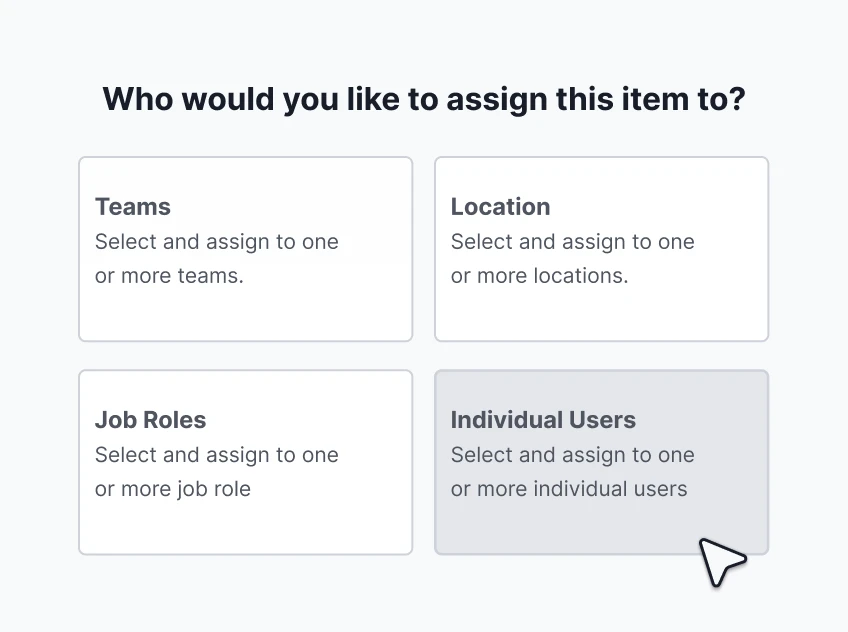
The kind of support a worker delivers sets its own requirements, before any individual participant comes into it. A SIL house needs mealtime management, medication and overnight practice. Community access needs transport, public behaviour and community safety. SDA brings the building itself into scope.
Set each house or service stream up as its own grouping in Ausmed Learn™ and attach enrolment rules to the grouping. A worker allocated to it is enrolled into what that context requires, with no request raised by anyone. It is the same mechanism that drives training by job role, pointed somewhere more specific. You maintain one rule set per context rather than a plan per worker.
Allocate someone to three groupings and they receive the requirement sets of all three, deduplicated. Remove them from a house and its requirements stop applying without disturbing the other two sets.
This is the mechanism that makes a casual pool workable. The question stops being "has this person done the induction" and becomes "which houses is this person currently cleared for".
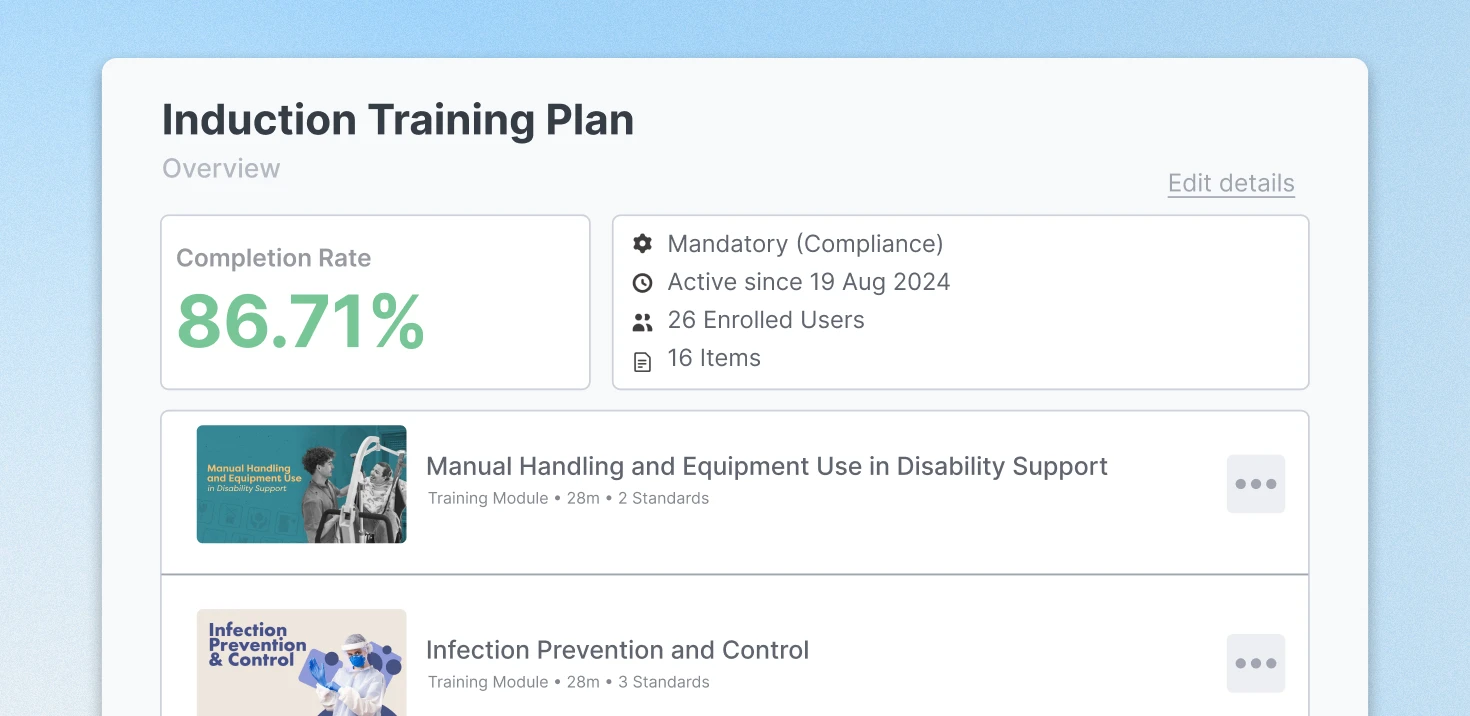
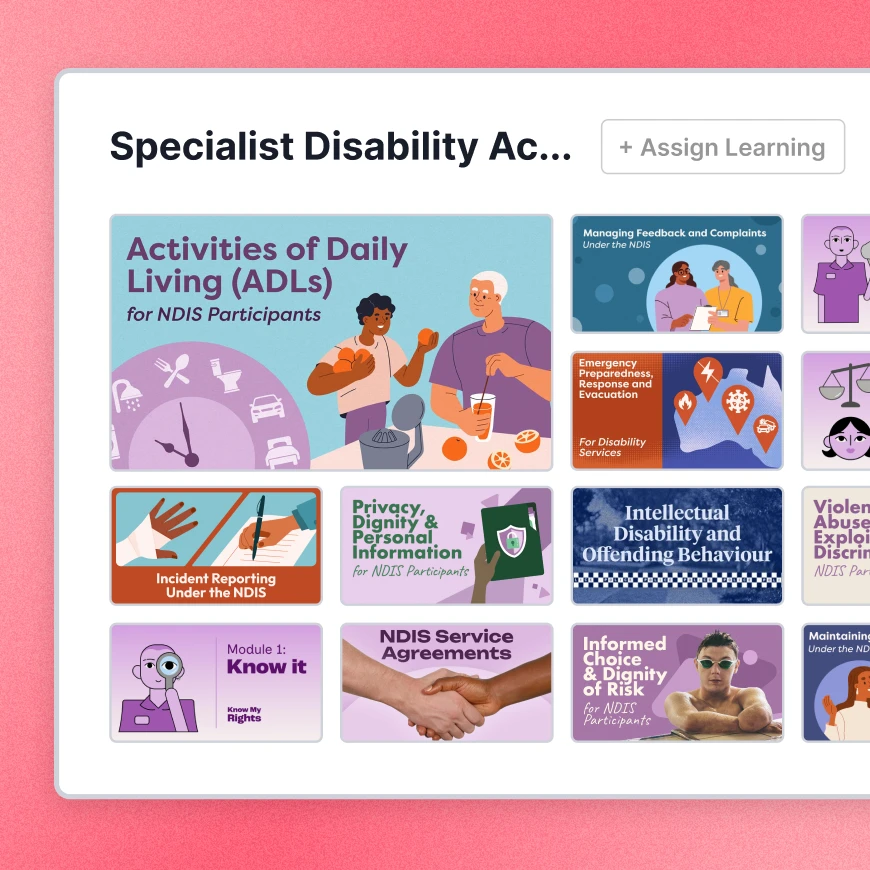
Open a SIL house with a similar support profile to one you already run and the requirement set comes with it. Adjust for what is different about the participants and the building rather than assembling it from scratch.
The same applies to taking on a house from another provider, which is how a lot of growth in this sector actually happens.
The SDA Module is mostly not about your workforce. Its five outcomes cover rights and responsibilities, conflict of interest, service agreements, enrolment of dwellings and tenancy management. Where it touches workers, it does so once, and it does so at a handover.
"The agreement includes information about dwelling safety features, including fire alarms and building evacuation procedures, and how this information will be communicated to other providers who deliver supported independent living to each participant in the dwelling."
If you are the SDA provider, you have to be able to show how that information reached the SIL workforce in the building, including a workforce you do not employ. If you are the SIL provider, you have to be able to show your workers received it. Either way the evidence is an induction record attached to the dwelling rather than to the person, and it has to survive turnover on both sides.
The same logic covers the rest of what a dwelling carries. Equipment and egress belong to the building, so they belong on the house grouping. A participant moving between SDA dwellings picks up a new set, and so does the worker who follows them.
Practice Governance in the SIL Module points the same way: emergency arrangements in shared living are to be "coordinated, rehearsed and tailored to individual needs". A rehearsal is an event with a date and a list of who was there, which is a record or it did not happen.
Pick a SIL house and we will map what it requires of a worker, what you can evidence for the current team, and what happens when somebody covers a shift there at short notice.
Across its four standards it names person-centred practice, trauma-informed practice, active support, supported decision-making, de-escalation, positive behaviour support and cultural safety. Practice Governance asks that workers are trained and assessed as competent in the evidence-based practices, and Supported Decision-Making is the one topic where refresher training is written into the indicator rather than left to you.
Lighter, but not nothing. The SDA Module requires your service agreement to cover dwelling safety features, including fire alarms and evacuation procedures, and to set out how that information will be communicated to the SIL providers working in the dwelling. You need a record that the communication happened, and it needs to be repeatable every time a SIL provider or its workforce changes.
Each SIL house is set up as its own grouping in Ausmed Learn™, and enrolment rules attach to the grouping rather than to individual workers. Anyone allocated to the house is enrolled into what that house requires.
They receive the requirements of every grouping they are allocated to, deduplicated, so a module required by two houses is assigned once.
Equipment that belongs to the dwelling sits on the house grouping, so it is assigned the same way. Where operating it safely needs more than a module, pair it with a competency assessment done on that equipment.
The requirement is the same whoever fills the shift. The difficulty is timing, because an agency worker needs to be cleared before they are allocated rather than after.
Ausmed is a Trusted Information Partner of Healthdirect Australia. Verify here.