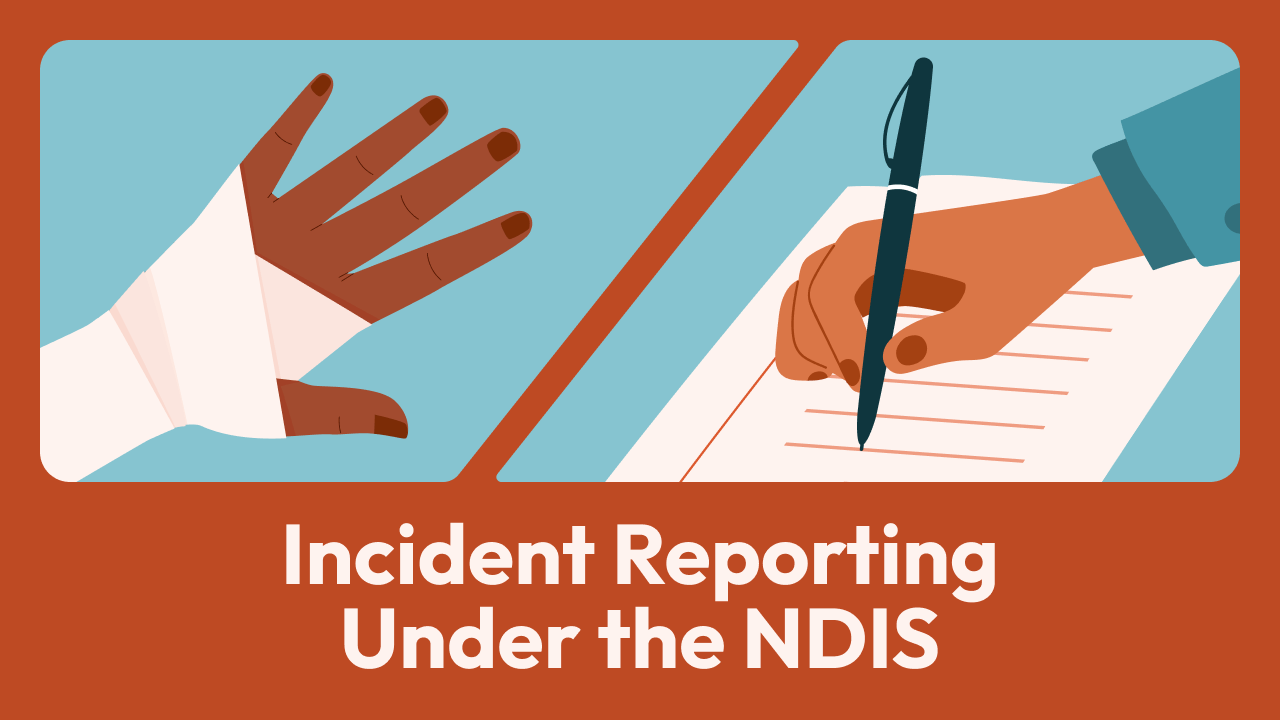
Incident Reporting Under the NDIS
CPDTime.
26m
Updated 27 Aug 2026 Certificate17 Ratings

Incident reporting is how disability workers and NDIS providers identify, respond to, record and report events that have harmed, or could harm, a participant, including where a participant causes or risks serious harm to another person. Because incidents can occur even when procedures are followed or no worker is present, knowing what constitutes an incident and how to respond helps protect participants’ safety, dignity and rights.

This Training Module discusses how to recognise incidents, near misses and reportable incidents, including the six reportable incident categories and the timeframes for notifying the NDIS Commission. It also covers how to respond to and support a participant immediately after an incident, how to record accurate and objective documentation, and how incident reporting drives continuous improvement across an organisation.

Content

6 Units • 12 Questions
Pre-reflection
1 Question
Unit 1: Introduction
1m
Unit 2: Understanding Incidents Under the NDIS
3 Questions
4m
Unit 3: Reportable Incidents Under the NDIS
3 Questions
6m
Unit 4: Responding to Incidents Safely and Ethically
2 Questions
6m
Unit 5: Documentation and Continuous Improvement
2 Questions
3m
Unit 6: Conclusion
1m
Post-reflection
1 Question

What you'll learn:

1

Identify incidents, near misses and reportable incidents.

2

Demonstrate how to respond to and report incidents according to workplace procedures.

3

Recognise how accurate incident reporting supports participant safety and continuous improvement.

Topics

For Teams
Assign to your staff

Assign mandatory training and keep all your records in-one-place.

Find out more


Meet your educator
Peer reviewed by
Content Integrity
Ausmed strives for the highest level of content integrity and accuracy in our educational resources.
Last updated27 Aug 2026

Published27 Aug 2026

Due for review31 Jul 2028
Disclaimer
Disclosure
Usage
Cite this resource

Recommended resources

Image for Hypoglycaemia Management in Aged Care
Hypoglycaemia Management in Aged Care
CPDTime.resource
24m
Lecture
Image for Insomnia in Older Adults: Assessment and Management
Insomnia in Older Adults: Assessment and Management
CPDTime.resource
24m
Lecture
Image for Insomnia in Older Adults: Introduction and Causes
Insomnia in Older Adults: Introduction and Causes
CPDTime.resource
16m
Lecture
Image for Insulin Therapy in Aged Care
Insulin Therapy in Aged Care
CPDTime.resource
34m
Lecture
Image for Pathology Interpretation
Pathology Interpretation
CPDTime.resource
28m
Lecture
Image for Prediabetes
Prediabetes
CPDTime.resource
31m
Lecture
Image for Prehospital-Diabetic Emergencies
Prehospital-Diabetic Emergencies
CPDTime.resource
34m
Lecture
Image for Recognising and Managing Cardiogenic Shock
Recognising and Managing Cardiogenic Shock
CPDTime.resource
21m
Lecture
Image for Sliding Scale Insulin: Best Practice Update
Sliding Scale Insulin: Best Practice Update
CPDTime.resource
15m
Lecture
Image for Unsettled Babies, Colic and Reflux
Unsettled Babies, Colic and Reflux
CPDTime.resource
28m
Lecture