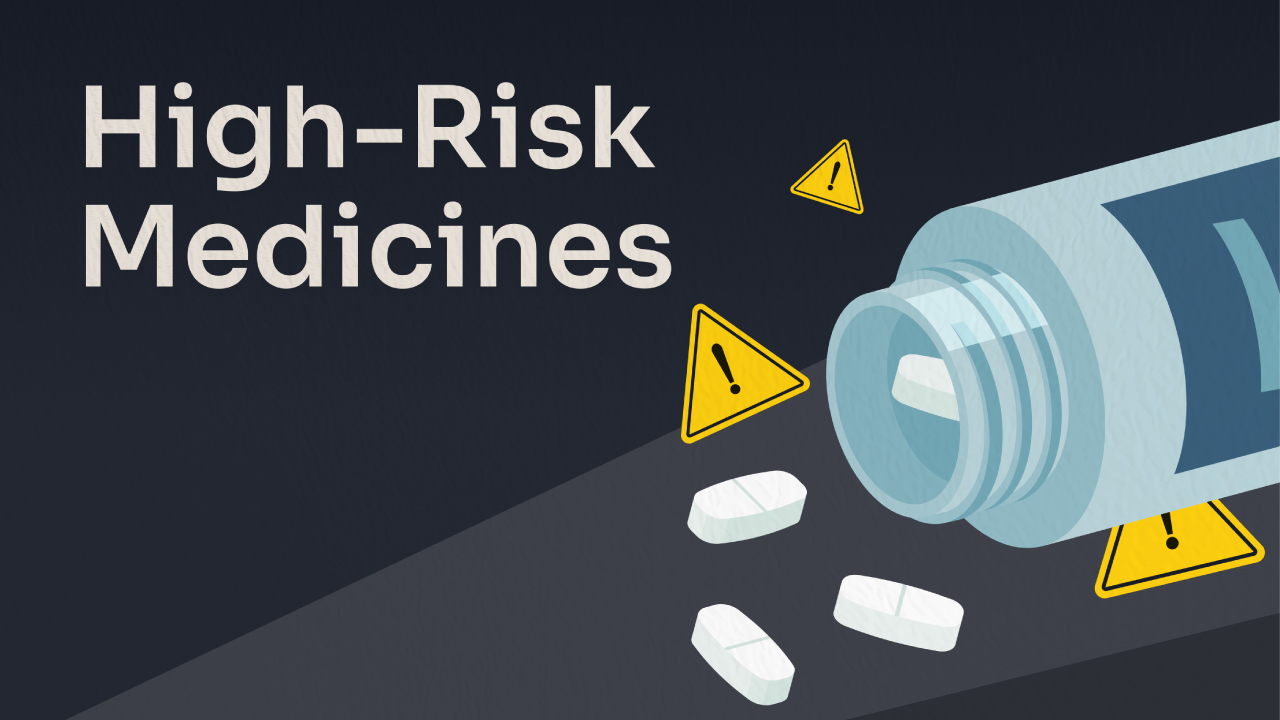
High-Risk Medicines

CPDTime.
38m
Updated 02 Mar 2026 Certificate929 Ratings

High-risk medicines (HRMs) are medications with a heightened potential to cause significant harm if used incorrectly. Errors involving these medicines are more likely to result in serious adverse outcomes, including hospitalisation and long-term injury.

This Training Module explores medicines commonly classified as high risk, the types of errors most often associated with their use, and factors that increase the risk of harm. It also outlines key principles and strategies for the safe management of high-risk medicines to support medication safety and reduce preventable patient harm.

Content

10 Units • 15 Questions
Pre-reflection
1 Question
Unit 1: Introduction
1m
Unit 2: High-Risk Medicines and Associated Errors
3m
Unit 3: A - Antimicrobials
2 Questions
3m
Unit 4: P - Potassium and other electrolytes
2 Questions
4m
Unit 5: I - Insulin
2 Questions
4m
Unit 6: N - Narcotics (opioids and other sedatives)
2 Questions
5m
Unit 7: C - Chemotherapeutic agents
2 Questions
4m
Unit 8: H - Heparin and other anticoagulants
2 Questions
4m
Unit 9: S - Systems
1 Question
4m
Unit 10: Conclusion
Post-reflection
1 Question

What you'll learn:

1

Identify medicines that are considered ‘high-risk’.

2

Explain errors commonly associated with high-risk medicines.

3

Recognise risks and errors when managing high-risk medicines.

4

Explain strategies for the safe management of high-risk medicines.

Who it's for:

This module is intended for registered nurses and medical officers who care for people prescribed HRMs in the home.

Purpose:

The purpose of this module will be to provide nurses and other healthcare professionals with current, evidence-based guidance on the safe use of HRMs to strengthen medication safety practices, improve recognition, and prevent avoidable errors, thereby minimising the risk of serious harm to patients and healthcare workers.

Topics

For Teams
Assign to your staff

Assign mandatory training and keep all your records in-one-place.

Find out more

Content Integrity
Ausmed strives for the highest level of content integrity and accuracy in our educational resources.
Last updated02 Mar 2026

Published02 Mar 2026

Due for review30 Mar 2028
Disclaimer
Disclosure
Usage
Cite this resource

Recommended resources

Image for Hypoglycaemia Management in Aged Care
Hypoglycaemia Management in Aged Care
CPDTime.resource
24m
Lecture
Image for Insomnia in Older Adults: Assessment and Management
Insomnia in Older Adults: Assessment and Management
CPDTime.resource
24m
Lecture
Image for Insomnia in Older Adults: Introduction and Causes
Insomnia in Older Adults: Introduction and Causes
CPDTime.resource
16m
Lecture
Image for Insulin Therapy in Aged Care
Insulin Therapy in Aged Care
CPDTime.resource
34m
Lecture
Image for Pathology Interpretation
Pathology Interpretation
CPDTime.resource
28m
Lecture
Image for Prediabetes
Prediabetes
CPDTime.resource
31m
Lecture
Image for Prehospital-Diabetic Emergencies
Prehospital-Diabetic Emergencies
CPDTime.resource
34m
Lecture
Image for Recognising and Managing Cardiogenic Shock
Recognising and Managing Cardiogenic Shock
CPDTime.resource
21m
Lecture
Image for Sliding Scale Insulin: Best Practice Update
Sliding Scale Insulin: Best Practice Update
CPDTime.resource
15m
Lecture
Image for Unsettled Babies, Colic and Reflux
Unsettled Babies, Colic and Reflux
CPDTime.resource
28m
Lecture