Falls in older people are often serious, resulting in functional decline, reduced quality of life, loss of independence and, in severe cases, even death (Stefanacci & Wilkinson 2025).
The Australian Institute of Health and Welfare (2025) identified falls as the leading cause of injury-related deaths in 2022-23, as well as the leading cause of injury hospitalisations in 2023-24. In that same period, Australians aged 65 and over were twelve times more likely to require hospitalisation following a fall compared to adults aged 25-44. The financial burden of these fall-related injuries on the Australian health system was estimated at over $5 billion during the 2023–24 period (AIHW 2025).
Despite these alarming statistics, most falls are preventable.
What is a Fall?
A fall is ‘an event that results in a person coming to rest inadvertently on the ground or floor or other lower level’ (DoHaAC 2025).
Most falls occur due to a combination of both intrinsic (personal) and extrinsic (environmental) factors. The more risk factors that are present, the more likely the person is to fall (WA DoH 2024).
Some common risk factors include:
| Intrinsic risk factors | Extrinsic risk factors |
|---|---|
|
|
(WA DoH 2024; Queensland Health 2026; Clay et al. 2018)
Older People and Falls
Changes to the body due to the normal ageing process can worsen existing risk factors or cause new ones to arise. Inadequate physical fitness, poor nutrition or hydration, illnesses and other conditions may compound this risk further (Healthdirect 2025).
In Australia, approximately 1 in 4 people aged over 65 will experience at least one fall a year (ACQSC 2026).Falls are the biggest cause of unintentional injury in older people over 65 (Healthdirect 2025).
Risk factors associated with age include:
- Balance issues and unsteadiness
- Muscle weakness and joint stiffness
- Poorer sensation in legs and feet
- Poorer eyesight
- Medication side effects
- Slower reaction times
- Memory difficulties
- Poor diet and dehydration
- Low levels of calcium
- New health problems (e.g. incontinence or dementia).
(Healthdirect 2025; Better Health Channel 2026)
Consequences of Falling
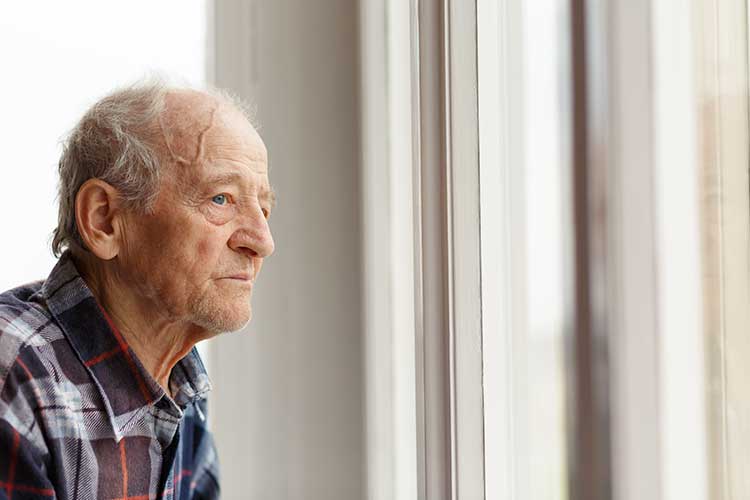
Even in cases where an injury does not occur, the person may develop a fear of falling that reduces their confidence and independence. This, in turn, only increases their risk of falling again in the future, as reduced physical activity can lead to poor balance, muscle weakness and stiff joints (Stefanacci & Wilkinson 2025; Healthdirect 2025).
Falls can lead to a variety of physical, emotional, social, short-term and long-term consequences, including:
- Bruises, sprained ligaments, strained muscles and soft tissue injuries
- Hip fractures (the most common injury caused by falls)
- Dislocations
- Broken bones
- Torn ligaments
- Deep cuts
- Respiratory infections
- Organ damage
- Loss of consciousness
- Head injury
- Impaired mobility
- Social isolation
- Loss of confidence and independence
- Embarrassment and low self-esteem
- Functional decline
- Hypothermia
- Family and carer stress
- Stiff joints and weak muscles due to lack of activity
- Increased risk of future falls
- Death.
(Stefanacci & Wilkinson 2025; Better Health Channel 2026; Healthdirect 2025; Horta Reis da Silva 2024)
Falls Prevention Under the Strengthened Aged Care Quality Standards
Standard 5: Clinical Care - Outcome 5.5: Safety of clinical care services under the Strengthened Aged Care Quality Standards (Action 5.5.4) advises aged care providers to establish processes for reducing falls and harm from falls by:
- Optimising older people’s mobility to reduce functional decline
- Providing appropriate and timely care after an older person has fallen
- Assessing fall and injury events to determine why they occurred and what the consequences were.
(DoHDA 2025)
Preventing Falls in Aged Care
Preventing falls requires a multifactorial approach that addresses each person’s modifiable risk factors (Clay et al. 2018).
Vulnerable people should be identified using a validated falls risk assessment tool, and appropriate interventions should be implemented. Multiple solutions will likely need to be implemented to target several individual risk factors (Clay et al. 2018).
Universal Precautions
The following are some universal precautions that aged care staff can take to prevent falls:
- Ensure effective communication between staff
- Ensure the person is familiar with their environment
- Ensure the person knows how to use any call lights or alert devices
- Ensure personal belongings (e.g. glasses, hearing aids) are within reach
- Answer call lights as soon as possible so that the person does not need to ambulate unnecessarily
- Remove debris from outdoor walkways (e.g. moss, slime, leaves)
- Repair any broken, uneven or damaged flooring
- Keep the floors clean, dry and free of clutter, and clean any spills as soon as possible
- Remove or tape down electrical cords
- Mark changes in the floor level with a bright colour
- Use non-slip mats in wet areas (e.g. bathroom, kitchen) and non-slip flooring
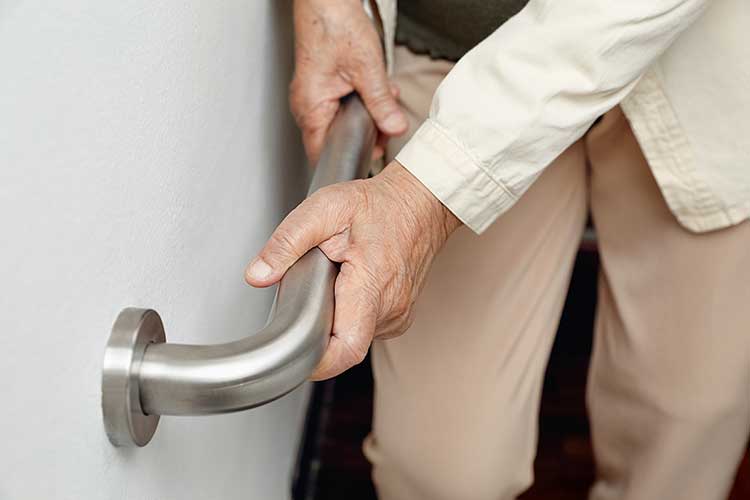
- Implement handrails, seats or handheld nozzles in the shower and bath
- Secure mats and rugs with adhesive strips; remove any that are torn or wrinkled
- Use bright lighting and nightlights to increase visibility and ensure lights are switched on
- Use curtains or blinds to reduce glare
- Change the lights if they are not bright enough
- Encourage the person to wear non-slip footwear
- Keep the older person’s bed at an appropriate height (their feet should be able to touch the floor with their hips, knees and ankles at a 90-degree angle) and lower it while they are resting
- Keep bed and chair brakes on
- Ensure older people know how to use mobility and assistive devices
- Avoid restrictive practices where possible
- Establish a bowel and bladder function care plan
- Ensure older people and staff are properly informed about any medicines that may increase the risk of falls.
(Performance Health 2019; ACSQHC 2025; Healthdirect 2025; Better Health Channel 2026)
Conclusion
Falls represent one of the most significant and costly challenges in aged care, yet with the right knowledge and a proactive approach, many can be prevented. By understanding the intrinsic and extrinsic risk factors that contribute to falls, identifying vulnerable individuals early, and implementing both universal precautions and targeted interventions, aged care providers can meaningfully reduce the frequency and severity of falls in their care settings.
Ultimately, fall prevention is about more than avoiding injury - it is about supporting older people to live with confidence, independence and dignity.
Test Your Knowledge
Question 1 of 3
Which one of the following is an example of an effective falls prevention strategy in aged care settings?
Topics
Further your knowledge
 FreeFree
References
- Aged Care Quality and Safety Commission 2026, Falls Awareness month, Australian Government, viewed 3 June 2026, https://www.agedcarequality.gov.au/news-publications/clinical-alerts-and-advice/falls-awareness-month
- Department of Disability, Health and Ageing 2025, Standard 5: Clinical care, Australian Government, viewed 3 June 2026, https://www.health.gov.au/resources/publications/strengthened-aged-care-quality-standards-august-2025?language=en/environment
- Australian Commission on Safety and Quality in Health Care 2025, Preventing falls and harm from falls in Older People, Australian Government, viewed 3 June 2026, https://www.safetyandquality.gov.au/sites/default/files/resources/attachments/falls-guidelines-for-community-care.pdf
- Australian Institute of Health and Welfare 2025, Injury in Australia: Falls, Australian Government, viewed 3 June 2026, https://www.aihw.gov.au/reports/injury/falls
- Better Health Channel 2026, Preventing falls at home, Victoria State Government, viewed 3 June 2026, https://www.betterhealth.vic.gov.au/health/healthyliving/falls-prevention-at-home
- Clay, F, Yap, G & Melder, A 2018, Risk Factors for in Hospital Falls: Evidence Review, Monash Health, viewed 3 June 2026, https://monashhealth.org/wp-content/uploads/2019/01/Risk-factors-for-falls_Final-27082018.pdf
- Department of Health and Aged Care 2025, National Aged Care Mandatory Quality Indicator Program Manual 4.0–Part A, Australian Government, viewed 3 June 2026, https://www.health.gov.au/sites/default/files/2025-03/national-aged-care-mandatory-quality-indicator-program-manual-4-0-part-a.pdf
- Healthdirect 2025, Older people and falls, Australian Government, viewed 3 June 2026, https://www.healthdirect.gov.au/falls
- Horta Reis da Silva, T 2024, Falls prevention in older people and the role of nursing, British Journal of Community Nursing, vol. 29, pp. 335-339, viewed 3 June 2026, https://doi.org/10.12968/bjcn.2024.0005
- Performance Health 2019, The Role of Nurses in Fall Prevention, Performance Health, viewed 3 June 2026, https://www.performancehealth.com/articles/the-role-of-nurses-in-fall-prevention
- Queensland Health 2026, Falls Prevention: Resources for professionals and service providers, Queensland Government, viewed 3 June 2026, https://www.health.qld.gov.au/public-health/groups/seniors/falls-prevention/resources-for-professionals-and-service-providers
- Stefanacci, RG & Wilkinson, JR 2025, Falls in Older Adults, MSD Manual, viewed 3 June 2026, https://www.msdmanuals.com/en-au/home/older-people%E2%80%99s-health-issues/falls-in-older-adults/falls-in-older-adults
- Western Australia Department of Health 2024, Risk Factors for Falls, Government of Western Australia, viewed 3 June 2026, https://www.health.wa.gov.au/Articles/F_I/Falls-prevention-and-management-in-WA/Research-and-education-in-falls/Risk-factors-for-falls