

Correct patient identification underpins safe practice across all care settings, ensuring every procedure, medication, and treatment reaches the right person (ACSQHC 2026).
Mistakes can and will happen, which is why correct identification and procedure matching are crucial for minimising risk and keeping our patients safe.
It is important to consistently verify the patient’s identity with their intended care throughout their hospital stay, with accurate documentation.
Correct Identification and Procedure Matching in the National Safety and Quality Health Service Standards
Correct identification and procedure matching are outlined in Actions 6.05 and 6.06 of the National Safety and Quality Health Service Standards, under Standard 6: Communicating for Safety.
Both Action 6.05 and Action 6.06 aim to ensure healthcare organisations have systems in place to accurately maintain patient identity and deliver the right care to every individual (ACSQHC 2021).
Action 6.05
To meet this action, organisations are advised to:
- Establish approved identifiers according to best-practice guidelines
- Use at least three approved identifiers upon:
- Registration and admission
- Providing care, medicines, therapy or other services
- Generating clinical handover, transfer or discharge documentation.
(ACSQHC 2021)
Action 6.06
To meet this action, organisations are advised to:
- Outline processes for correctly matching patients to their care
- Document the process of correctly matching patients to their intended care.
(ACSQHC 2021)
What are the Approved Identifiers?
There are six approved identifiers that can be used to ensure the right patient is matched with the right procedure. These include:
- Name (family and given names combined are one identifier)
- Address
- Date of birth
- Gender (as identified by the patient)
- Patient healthcare record number if assigned
- Individual Healthcare Identifier (IHI) (a unique 16 digit number assigned for healthcare purposes).
(RACGP 2023; DHDA 2025)

Three identifiers must be used every time a procedure is discussed with the patient or about to be carried out to safeguard against medical errors or breaches of confidentiality. When two or more patients in the same clinical area share the same or similar name, the risk of misidentification or incorrect procedure matching increases significantly. While each organisation will have its own policy, common safeguards include placing cautionary cards on patient health records and adding alerts to ward lists, handover sheets, and other relevant documentation (WACHS 2023).
Note: Medicare numbers are not an approved patient identifier. Not all Australian residents and visitors have a Medicare number, and in some cases, Medicare details may be shared among family members.
Where a patient requests to remain anonymous, an alias or disguised identity might be used. However, you must refer to your organisation's policy for guidance in these circumstances (RACGP 2023).
Asking the Patient for Identifier Information
As soon as the patient enters the clinical space, it is crucial to check that they are the expected person for the planned procedure or care.
Clinical registration or hospital admission policies need to clearly document how to identify the patient using three of the approved identifiers.
This information should be obtained by:
- Checking the appointment letter against the patient list
- Asking the patient to state key identifiers - typically name, address and date of birth
- Ensuring that all documentation, medical notes and electronic systems used match the patient in front of you, including documentation from different clinical areas
- Government-issued photographic identification (such as a driver's licence or passport) may be used by patients to confirm their identity, as well as one or more subsequent patient identifiers at the point of registration
- Using open-ended questions rather than closed questions (such as 'what are you here for?' or 'what is your name?' instead of 'are you, John Smith?')
- When appropriate, ask the patient to confirm or point to the area they are receiving the procedure
- If the patient is unable to confirm the details, the details must be confirmed with the patient’s designated representative
(RACGP 2023; QLD Health 2022)
Staff should always ask patients to state their identifying information, rather than reading it out and asking the patient to confirm (RACGP 2023).
What Information Must You Record and Document?
Good documentation is key to good clinical practice. It is important to clearly, accurately and safely record the approved identifiers in the individual’s health record. If both electronic and paper-based documentation are used, it is important to cross-check both for accuracy (RANZCP 2025).
For more information on the principles of good record keeping, see Record Keeping and Documentation.
ID Band Specifications
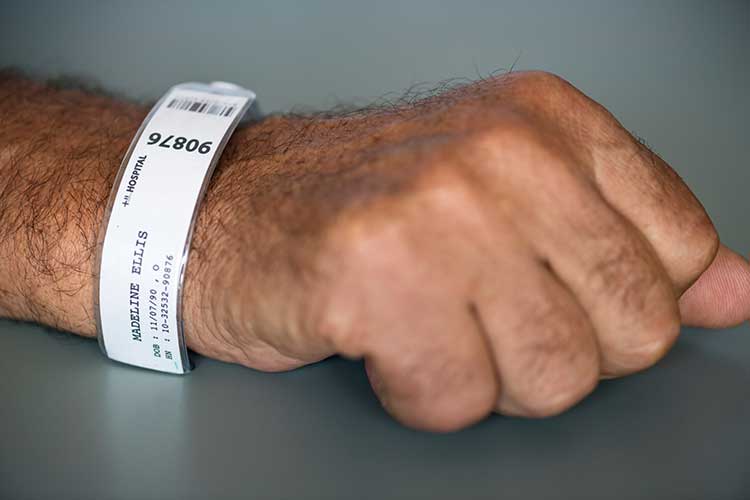
The patient identity wristband is consistently used to verify the patient’s identity throughout the hospital stay and at each stage of treatment.
Whether it uses barcode technology or printed details, it is paramount that all details are correct so that a positive identification can be confirmed.
The Australian Commission for Safety and Quality in Health Care has developed specifications for a national patient identification band to ensure standardised best practice across the country.
Based on the principle that the primary purpose of the identification band is to identify the patient, the Commission advises that black text on a single white band with the core patient identifiers is the safest and most reliable way to present this information. If the individual has an allergy, the only approved coloured identification band is red (ACSQHC 2012).
The identity band should only contain the following information:
- Name
- Date of birth
- Medical record number (MRN)
(ACSQHC 2012)
Family and given names should be clearly differentiated to prevent misidentification. The family name should appear first in upper case letters followed by the given names in title case, e.g. ‘DOE Jane’. Date of birth should also be recorded in the DD/MM/YYYY format (ACSQHC 2012).
It’s important to remember that the wristband isn’t always right.
Errors can occur when inputting information into the computer system and may not be immediately spotted, so always ensure that you check the wristband with something else, such as the medical notes and your patient.
Clinical Handover and Double Independent Checking
Whenever a clinical handover occurs, it is critical that all staff who are involved check the identity of the patient using three of the approved identifiers, ideally with the patient involved (RCH 2024).
If using electronic medical records (EMR), confirm the patient identification details before scanning the patient's ID band (RCH 2024).
In some instances, such as blood transfusions, 'double independent checking' is required, whereby two clinicians independently verify the patient's identity without direct involvement of each other (DoH 2025).
Misidentification and Sentinel Events
The term 'sentinel event' refers to a serious incident that is 'wholly preventable and has caused serious harm to, or the death of, a patient' (ACSQHC 2025). One of the 10 recognised types of sentinel events in Australia is 'surgery or other invasive procedure performed on the wrong patient resulting in serious harm or death' (ACSQHC 2025). Although rare, this type of event does occur, with one case reported in both 2019-20 and 2021-22 (CEC 2026).
Patient safety incidents and near misses associated with incorrect patient identification are a recognised problem internationally and have been identified as a key patient safety goal by agencies around the world.
When we fail to identify a patient correctly and match them with their intended procedure, the results can be disastrous. Potential consequences that might occur due to patient misidentification include:
- The wrong procedure being performed, or a procedure being performed on the wrong person, wrong side or wrong site
- Medication errors
- Blood transfusion errors
- Incorrect diagnostic tests being performed.
(ACSQHC 2025)
Patient safety incidents related to misidentification reported across Australia:
- In 2023, 'wrong blood in tube' errors were estimated at 4.3–5.8 per 10,000 samples
- In 2022-23, there were 7 surgeries performed on the incorrect body part
- In 2023-24, this was reduced to 4 surgeries performed on the incorrect body part
- In 2023-24, there were 51 medication errors resulting in serious harm or death
(CEC 2026; DoH 2023)
To support clinical teams in preventing these errors, the Royal Australasian College of Surgeons has developed Surgical Safety Checklist and Implementation Manual, a national strategy adapted from the World Health Organization's Surgical Safety Checklist (RACS 2009; WHO 2008).
For more information on the types of sentinel events, see Australian Sentinel Events List Specifications
Conclusion
Patient identification errors can occur anywhere within the healthcare process and at any healthcare facility, which is why preventing mistakes is crucial.
Knowing and following your organisation's policies and processes with every patient is the best way to keep them safe and ensure they receive the treatment intended for them.
Test Your Knowledge
Question 1 of 3
"Surgery or other invasive procedure performed on the wrong patient resulting in serious harm or death" is classified as what type of event in Australia?
Topics
References
- Australian Commission on Safety and Quality in Health Care 2025, Australian Sentinel Events List (Version 2), Australian Government, viewed 1 June 2026, https://www.safetyandquality.gov.au/publications-and-resources/resource-library/australian-sentinel-events-list-version-2-specifications
- Australian Commission on Safety and Quality in Health Care 2021, National Safety and Quality Health Service Standards, 2nd ed., Australian Government, viewed 1 June 2026, https://www.safetyandquality.gov.au/resources/national-safety-and-quality-health-service-standards-second-edition
- Australian Commission on Safety and Quality in Health Care 2026, Patient identification and procedure matching, Australian Government, viewed 1 June 2026, https://www.safetyandquality.gov.au/national-standards/nsqhs-standards/communicating-safety-standard/further-information-communicating-safety/patient-identification-and-procedure-matching
- Australian Commission on Safety and Quality in Health Care 2012, Specifications For a Standard Patient Identification Band, Australian Government, viewed 1 June 2026, https://www.safetyandquality.gov.au/sites/default/files/resources/attachments/Specs-PatID-Band.pdf
- Clinical Excellence Commission 2026, Sentinel Events reporting, New South Wales Government, viewed 1 June 2026, https://cec.health.nsw.gov.au/incident-management/biannual-report/sentinel-events
- Department of Health 2025, Positive patient identification and pretransfusion checking procedure, Victorian Government, viewed 1 June 2026, https://www.health.vic.gov.au/sites/default/files/2025-03/att1-pretransfusion-checking-audit-2025.pdf
- Department of Health 2023, Wrong blood in tube (WBIT) - what can we do to reduce errors?, Victorian Government, viewed 1 June 2026, https://www.health.vic.gov.au/sites/default/files/2023-09/blood-matters-stir-bulletin-10-wrong-blood-in-tube-sep-2023.pdf
- Royal Australasian College of Surgeons 2009, Surgical Safety Checklist and Implementation Manual, viewed 1 June 2026, https://www.surgeons.org/Resources/reports-guidelines-publications/useful-guides-standards#Surgical%20Safety%20Checklist
- The Royal Children’s Hospital Melbourne 2024, Policies and Procedure: Patient Identification Procedure, viewed 1 June 2026, https://www.rch.org.au/rchcpg/hospital_clinical_guideline_index/Nursing_clinical_handover/
- The Royal Australian and New Zealand College of Psychiatrists 2025, Documentation, legislation and storage of patient health records, viewed 1 June 2026, https://www.ranzcp.org/clinical-guidelines-publications/in-focus-topics/private-practice-resources/patient-health-records/documentation-legislation-and-storage-of-patient-health-records
- The Royal Australian College of General Practitioners 2023, Standards for General Practice, 5th ed., viewed 1 June 2026, https://www.racgp.org.au/running-a-practice/practice-standards/standards-5th-edition/standards-for-general-practices-5th-ed/core-standards/core-standard-6/criterion-c6-1-patient-identification
- World Health Organization 2008, WHO Surgical Safety Checklist, viewed 1 June 2026, https://www.who.int/teams/integrated-health-services/patient-safety/research/safe-surgery/tool-and-resources
- Western Australia Country Health Service 2023, Patient Identification and Procedure Matching Policy, Government of Western Australia, viewed 1 June 2026, https://www.wacountry.health.wa.gov.au/~/media/WACHS/Documents/About-us/Policies/Patient-Identification-and-Procedure-Matching-Policy.pdf?thn=0
- Queensland Health 2022, Patient identification and procedure matching in diagnostic imaging, Queensland Government, viewed 1 June 2026, https://www.health.qld.gov.au/system-governance/policies-standards/guidelines/patient-identification-diagnostic-imaging
Additional Resources
- Surgical Safety Checklist and Implementation Manual
- Specifications for a Standard Patient Identification Band
- The National Safety and Quality Health Service Standards (NSQHS) Explained
- Record Keeping and Documentation for Non-Clinical Staff
- Documentation and Report Writing
- Two Person Independent Checking (I check and U check for safe transfusion) Poster